
Should you be forced to register with a GP in your Local Authority?
The health system has been clear for some time that GPs should sit at the heart of “neighbourhood health”. The aspiration is right: strong, connected primary care acting as an anchor within local communities, helping not only to treat illness but to prevent it.
Yet, aside from some excellent examples around the country, too often this is not what we see in practice. GPs, like every other statutory service, are doing their best to care for the patients in front of them. But they rarely have the capacity, or the system support, to play a meaningful role in preventing demand or addressing the wider determinants of health.
If GPs are to function effectively as community organisations, they need to be embedded in a dense network of local relationships. That means strong, active links with VCSE organisations, housing providers, local government, and social care amongst others. These relationships are not a “nice to have” they are essential if neighbourhood health is to be more than a slogan.
The problem is structural. GPs are allowed to register patients from a very wide geographic area. In rural settings this may be less of an issue, but in urban areas, particularly in London, it becomes a serious barrier to building and sustaining local partnerships.
Think about the relationships you would expect a truly effective GP practice to have. Near the top of the list would be:
- The local housing provider
- The local public health team
- Reablement and discharge support services
- Adult social care
- Children’s social care
Every one of these services is provided, or at least commissioned, by the local authority. And crucially, residents can only access these services from the local authority covering where they live.
Yet staggeringly, this logic does not apply to GP registration. You are not limited to joining a GP practice within your local authority area.
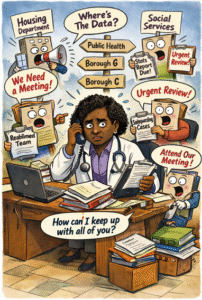
The result is predictable. GP practices end up with patient lists spanning multiple local authorities. I recently worked with a London GP who could name seven different boroughs, each accounting for at least 5% of their registered population. Taking just the services listed above, that single practice would need to build and maintain effective relationships with 35 different local authority teams to properly support its patients.
That is plainly impossible. And because it is impossible, most GPs simply don’t do it.
Viewed from the local authority side, the situation is no better. Because residents are registered with practices across and beyond council boundaries, a single council may have citizens registered with hundreds of GP practices. In theory, the council should be working closely with all of them. In reality, meaningful relationships form with very few.
The only serious defence of this arrangement is the “choice” it gives patients. But we are sacrificing better healthcare, stronger communities, and more effective prevention on the altar of choice.
Even then, the argument is weak. Restricting registration to GPs within a local authority would still leave substantial choice. A typical London borough has roughly 25 GP practices. That is more than enough for patients to exercise meaningful preference without undermining the foundations of neighbourhood health.
If we are serious about building stronger, better-connected, and healthier neighbourhoods, we need to confront the systemic barriers that make this so difficult. Allowing GP registration across wide and arbitrary geographies is one of them.
Limiting GP registration to a patient’s local authority area would be a simple change, but it would be a powerful one.